Nonpartisan Education
Review / Essays
Access
this essay in .pdf format
Access
this essay in .docx format
Rethinking
the Structure of American Secondary Education
Qianruo
Shen
July
2026
Abstract
This essay examines the strengths and structural challenges of
American secondary education from a comparative perspective informed by
educational experience in both China and North America. While recognizing the
achievements of American schools in holistic education and differentiated
talent development, and
the encouragement of creativity and innovation, it
argues that the comprehensive high school, together with unrestricted course
choice and the class-shifting system, reflects a broader transformation in
secondary education—a gradual loosening of its institutional structure. As a consequence, graduation standards have been lowered,
curricular structure and educational continuity have been weakened, and the guidance
and sense of community essential to adolescent development have been
diminished.
The paper argues that restoring
appropriate academic tracking, rebuilding class communities, and establishing a
more structured curriculum with stronger core requirements would help rebalance
flexibility and structure while preserving the enduring strengths of American
education.
1. Introduction
K–12 education has become an
increasing focus of public concern in the United States. Although recent years
have seen some recovery in STEM development and workforce growth, improvements
in foundational student learning have remained limited; in mathematics and
science, performance has often stagnated or declined, as documented by PISA and
TIMSS assessments. These are the very disciplines that once anchored the
nation’s technological leadership and underpinned its industrial strength.
Moreover, American education exerts major global influence, making its
long-term development a matter of broad international significance.
Having studied and taught in both China and North America, I have
had the opportunity to observe different approaches to education and some of
their long-term implications. Much of my work has focused on
comparative education, involving
research and collaboration with scholars across both regions. It has examined
how systems, policies, curricula, and classroom practices shape learning
outcomes. These cross-cultural experiences
provide a vantage point from which to reflect on the
ideals and realities in American K–12 education.
This essay offers a comparative perspective on the features and challenges of the
structure and governance of American secondary education, and
considers how certain educational foundations have been affected—and how they
might be strengthened.
2. Overall Impression: A Mixed Picture
In my view, traditional Western
educational ideals—such as holistic humanistic education, independent and
critical thinking, and the encouragement of creativity and innovation—remain
deeply valuable. In the United States, specialized schools, gifted programs,
academic competitions, and other elite pathways have maintained high standards
and continue to nurture outstanding talent.
My grandchildren’s schooling has
further reinforced these impressions. Over the past decade, they have attended
Montessori, Christian, and public schools in the United States and Canada.
Loving and dedicated teachers, respectful relationships between teachers and
students, and children who enjoyed schooling while developing kindness and
integrity all left me with lasting admiration. Notably, they never encountered
discriminatory remarks toward Asian or Chinese students.
Yet the weaknesses are equally
striking. As a Ph.D. teaching assistant and later a college instructor, I was
often astonished by students’ weak foundations. Many struggled with word
problems, simple geometric proofs, or the basic principles of Newton’s or Ohm’s
laws. When questions were raised in class, students often waited for the
teacher’s answer rather than thinking through the problem themselves.
Examinations that would be considered moderate in China were sometimes regarded
as excessively difficult.
A bright college student once told
me he envied Chinese students for having parents who supported them through
college. His
frustration reflected a broader sense that many students were not receiving the
education they deserved.
A similar pattern appeared in my
grandchildren’s schooling. When helping them with physics and mathematics, I
frequently had to reconstruct the logic step by step, as course sequencing that
lacks coherence forced students to expend excessive effort merely to grasp
basic ideas, and sometimes they were given formulas without sufficient
conceptual explanation.
These experiences are not isolated anecdotes but reflect broader
trends confirmed by international assessments.
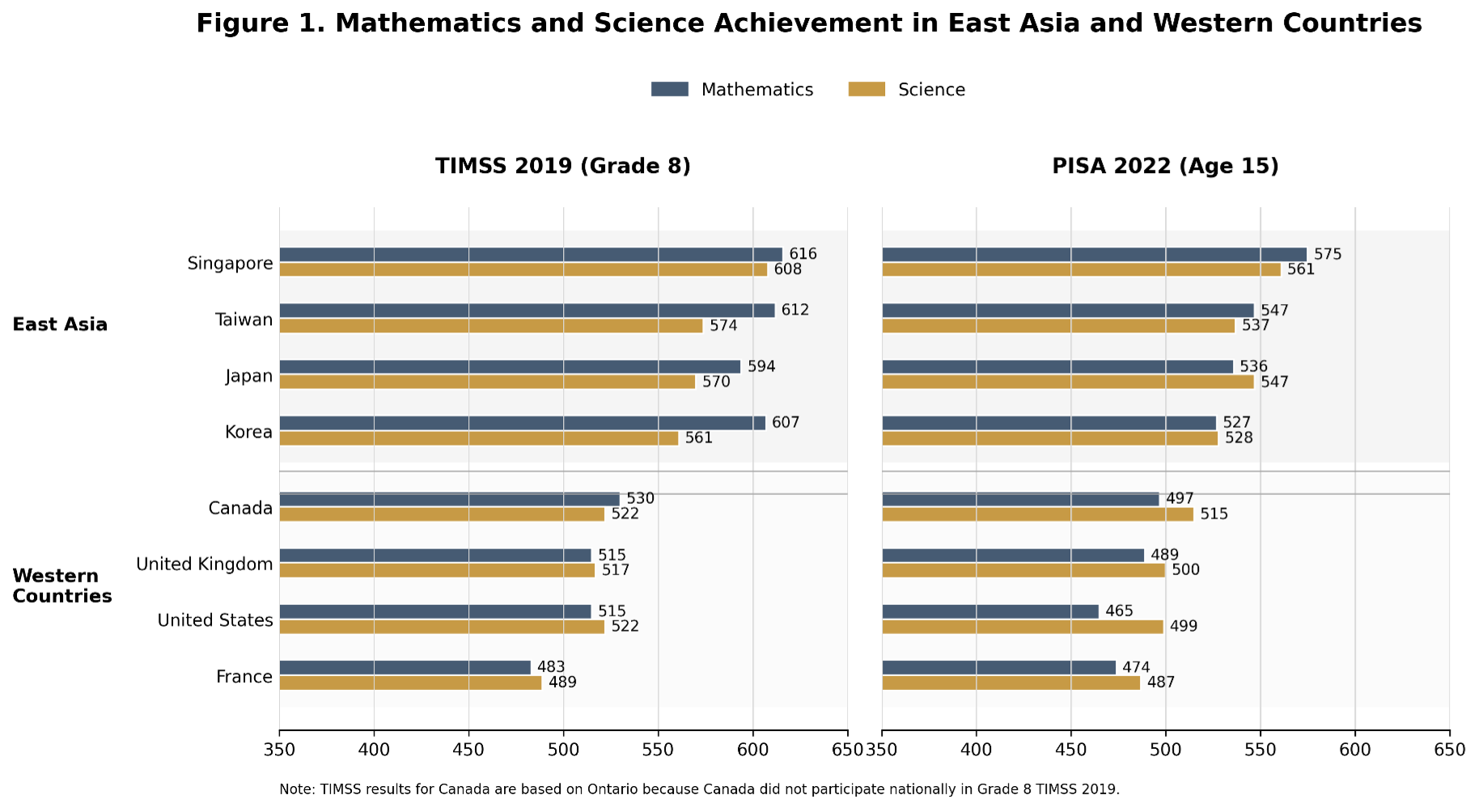
Figure 1 compares PISA and TIMSS
mathematics and science scores across eight Western and East Asian systems. East Asian systems perform at a high level,
while Western countries lag far behind, creating a clear East–West divide.
Compared with Singapore, the United States trails by more than 100 points in
mathematics and roughly 60–80 points in science.
Although test scores should not be
equated with actual ability, the substantial gap between two different types of
education systems nevertheless serves as a powerful warning.
3. Strengths of American K-12
Education
3.1
Goals and Methods of Holistic Development
If you ask Chinese immigrants in
North America what they most admire about K–12 education here, their answer is often its
commitment to holistic development—nurturing not only intellect but the whole
person.
In my grandchildren’s schools, this ideal was vividly reflected in daily practice. Students learned through hands-on experiences: visiting farms and apiaries, gardening, and caring for small animals on campus. Project-based learning was popular. In thematic exhibitions—on topics such as food or world cultures—students gathered materials, designed displays, and presented their findings to the audience.
Extracurricular programs were equally rich: school bands and performances, sports teams and tournaments, camping, and debates, among others. Western students are especially enthusiastic about sports—skating, skiing, and a wide range of ball games.
Such activities broadened students’ horizons, strengthened communication and collaboration skills, and cultivated teamwork, leadership, and civic awareness. They became confident and independent—quite different from many of their peers in China.
By contrast, China’s primary and secondary schools today focus
almost exclusively on academic achievement, especially exam results. The fierce
competition for university admission leaves little time for physical activity
or practical experience. The days when boys played soccer after class or when ping-pong
tables stood in every neighborhood are long gone. In my teenage years,
secondary students spent two weeks each semester in rural labor—an experience
now lost to history. The decline in students’ physical fitness, particularly
the lack of vigor among boys, has become a growing national concern.
3.2 Multiple Pathways for Talent Cultivation
Teaching according to individual
aptitude and differentiated instruction have long been hallmarks of Western
education. Gifted classes are designed to meet the needs of high-achieving
students rather than to serve examinations or utilitarian goals; students and
parents choose what suits them best and rarely complain about “fairness”—a
sharp contrast with attitudes in China. Many students take upper-grade courses
early, freeing time in grades 11–12 for advanced mathematics and science.
Students can also pursue advanced
secondary diplomas by completing additional mathematics and science
examinations. Gifted students frequently explore their interests through
competitions such as the American Mathematics Competitions (AMC), the
International Science and Engineering Fair (ISEF), and Olympiads in
mathematics, physics, and chemistry, which foster independent
thinking and genuine scientific ability.
Elite U.S. high schools—public
science and math schools, a number of arts-focused
institutions, and about 300 top private or IB schools—maintain rigorous
standards through structured curricula and unified assessments. Ordinary
schools, by contrast, vary widely in quality, so the responsibility for
cultivating top science and technology talent has largely fallen to these elite
institutions.
Support for students with
disabilities is also strong: they are integrated into regular classrooms
whenever possible and receive individualized instruction from special-education
teachers, supported by generous funding.
Taken
together, these systems offer students multiple pathways for growth. The
principle of teaching
according to aptitude, advocated by both Socrates and Confucius,
has been realized more fully in the West than in China, where schooling remains
more unified and rigid.
3.3 The
University Elimination System
In China, anxiety over the
university entrance examination has reached the point of obsession. Although
competition for college admission in the United States and Canada is also
intense, it is far less overwhelming.
A key reason lies in the
elimination system in Western higher education: most universities follow the
principle of easy entry but strict exit, while elite
institutions maintain both strict entry and strict exit. This arrangement
shifts the pressure of competition from the admission stage to the university
years, encouraging students to prove themselves through sustained performance
rather than a single exam.
China could draw valuable lessons
from this model. The common saying that “one exam determines one’s life”
reflects a system in which nearly everyone can graduate once admitted. If
universities adopted a genuine elimination mechanism, the anxiety surrounding
entrance examinations would ease, and students would be more likely to focus on
meaningful learning rather than rote preparation or simply “muddling through”
to obtain a diploma.
Such a system would also encourage greater flexibility. Students
who struggle could transfer to different programs or change majors instead of
being trapped by a single early decision.
4. The Loosening of Institutional Structure
Yet the same openness and
pluralism that underpin many of the strengths discussed above have also
produced unintended structural consequences. Three features of North American
secondary education—the comprehensive high school, the excessive course choice,
and the class-shifting system—appear different in form, but all reflect a
common trend: the gradual loosening and weakening of institutional structure in
the pursuit of flexibility, autonomy, and equality.
4.1
When One Size Fits All: The
Trouble with Comprehensive Schools
The impact of the comprehensive
high school on American secondary education has long been debated. Jeffrey
Mirel, for example, raised the question of whether and to what extent the
comprehensive high school has contributed to the decline in the quality of
secondary education.[1]
Globally, secondary education follows two
models: the “dual-track
system”, separating academic and
vocational-technical schools; and the “single-track system”, merging them into comprehensive schools.
Across Europe, the dual-track
model remains the norm. Vocational and technical schools stand on equal footing
with general high schools, enrolling the majority of
junior secondary graduates. In Asia, the economic rise of South Korea,
Singapore, Taiwan, and Hong Kong during the 1970s–80s was likewise supported by
strong vocational systems.
China’s pre–Cultural Revolution
“tripod system”—comprising general, normal (teacher training), and technical
schools, all at secondary level—also functioned effectively. I recall that my
elementary teachers, trained in normal schools, taught mathematics and Chinese with
solid mastery. While in the factory where I once worked, skilled workers from
technical schools were well paid and respected. The dual-track system was
dismantled during the Cultural Revolution, but has
been largely rebuilt in the reform and opening years.
By contrast, the United States and
Canada follow the single-track model dominated by comprehensive high schools,
with only a small number of specialized vocational-technical schools or
programs remaining in a few states or provinces. Students typically
complete twelve years of general schooling before pursuing specialized
training.
Courses in comprehensive schools range widely—from applied math to pre-calculus, from
typing and woodworking to Advanced Placement. Designed to meet diverse needs,
comprehensive schools often resemble the futile task of “pressing down ten
fleas with ten fingers”: they struggle to provide college-bound students with
rigorous preparation while offering career-oriented students only superficial
electives.
In China, a high school’s success
is measured by its college admission
rate; however in the United States and Canada, by its graduation rate. To maintain
high graduation figures, standards are often lowered.
High school dropout remains a
persistent challenge in many school districts.[2]
Those uninterested in academics would naturally turn to vocational
training, yet the system provides neither adequate preparation nor early
employment pathways. Many drift between school and street while others prepare
for college.
As a matter of fact, national studies find that students in vocational-technical high schools are
less likely to drop out. In states that have maintained these schools—such as Massachusetts and Connecticut—students show markedly
higher graduation rates than their peers in regular comprehensive schools.[3]
Education should evolve from a
unified approach in primary school to differentiation in high school, as
students vary in temperament, ability, and aspiration and will eventually enter
diverse industries and careers. By the senior secondary stage, their paths have
already diverged; forcing all students into one track hinders individual growth
and deprives society of much-needed skills.
The comprehensive high schools
originated in the early twentieth century, but its widespread adoption as the
dominant model of secondary education occurred mainly during the 1960s and
1970s. They are intended to promote equality, as part of the movement for
“educational democratization”. In reality, however,
their lowered standards may have weakened social mobility, widened inequality,
and left society more—not less—divided.
Earlier, I emphasized the strength
of American education in offering “multiple pathways for talent cultivation”. A
dual-track system should be recognized as an essential part of that strength.
Unfortunately, this link was cut off in the pursuit of absolute
equality, though Europe and much of Asia wisely
retained it—offering a fuller basis for reflection.
4.2 When Choice Lowers Standards: The
Hidden Cost of Course Selection
Free course selection is often
praised for granting students autonomy. In theory, it sounds ideal: whether
academically inclined or career-oriented, strong or struggling, every student
can choose courses aligned with personal strengths and goals. The system
promises freedom, growth, and diversity—virtues long celebrated as engines of
Western innovation.
This is true, especially for
students with high academic potential. Yet its fruits are not all sweet. For the majority of ordinary students, when freedom exceeds
responsibility, rigor is the first to disappear.
Many students tend to avoid
demanding subjects, opting instead for easier courses that still count toward
graduation. In British Columbia, for instance, students in Grades 10–12 must
complete twenty courses, yet only four are required in math and science.[4]
With such minimal requirements, countless students graduate without ever taking
senior-level mathematics, physics, or chemistry.
Moreover, without firm guidance,
freedom easily turns into confusion. Many students and parents lack the
knowledge to plan wisely, leading to detours, gaps, and needless repetition.
As critics have observed,
unrestricted course choice has gradually turned the curriculum, to some extent,
into a "cafeteria-style
curriculum," in which "the appetizers and desserts can
easily be mistaken for the main course."[5]
This concern was further developed by Arthur G. Powell,
Eleanor Farrar, and David K. Cohen, who argued that the modern comprehensive
high school increasingly resembled a "shopping mall," offering an
ever-expanding menu of courses that often came at the expense of academic
coherence.[6] This weakens curricular structure and coherence, and
makes it more difficult for students to acquire
a solid academic foundation.
The consequences are predictable:
relatively few students pursue science or engineering. Even among those who
begin in STEM programs, roughly one-third switch to other majors due to the
difficulty. Over time, this has left North America chronically short of
scientific and technical talent.
In particular, the shortage of
teachers and students is mutually reinforcing. Given that only about 10 to 15
percent of high school students take physics in the first place,[7]
it is hardly surprising that 2 in 5 of U.S. high
schools today lack teachers to offer the subject.[8]
This self-perpetuating cycle makes it increasingly difficult to rebuild a
strong foundation in science education.
The current shortage of STEM
talent can be traced back to the seeds sown decades ago—when choice began to
take precedence over structure.
The tension between freedom and
structure runs through all education systems, and China’s experience offers a
revealing contrast. In the 1920s, China briefly experimented with an
American-style credit and class-shifting system but abandoned it within a decade
due to public dissatisfaction, returning to the class-based model that ensured
greater consistency in educational quality. More recently, when a loophole
allowed students to avoid physics in the national university entrance
examination, it was quickly closed to guarantee that enough capable students
continue studying the most demanding of the sciences. Yet the other extreme
poses its own problems. As stated above. China’s system still suffers from
excessive unification and rigidity.
Elective courses and
differentiated teaching are indeed necessary, but they must rest on clearly
defined standards tailored to different student types. In this respect,
Singapore’s tracking system may provide a useful reference—structured to
maintain rigor while allowing flexibility to nurture diverse talents.[9]
4.3 The Missing Class System as a Safeguard for Growth
Free course selection makes fixed
classes unworkable, forcing schools to adopt a class-shifting system. Students
no longer have a permanent class or homeroom teacher; instead, they move from
one subject group to another in a kind of “free-range” state, like the
situation in a university. Each grade is typically assigned only one or two
counselors to manage course selection and student affairs. This has become the
standard administrative model in North American public schools.
For adolescents—especially those
in middle school—the class system serves as a vital safeguard for both academic
progress and personal growth. A sense of belonging to a community, the care and
supervision of a homeroom teacher, teamwork, role models, and close friendships
are all indispensable to a child’s development and form an essential part of
growing up.
Elementary
schools in the United States and Canada still operate under a class-based
system with close teacher oversight. But once students enter secondary schools,
they are largely left to themselves. Feelings of loneliness and helplessness
are difficult to avoid, particularly among introverted children. When the
“rebellious phase” of adolescence begins, such isolation can be especially
harmful—even dangerous.
My daughter experienced this
firsthand. She came to Canada just before entering middle school and soon found
herself in a completely different language and cultural environment, feeling
isolated and adrift. Looking back, I regret not spending more time with her
during that difficult transition.
The lack of guidance and
discipline under class-shifting has contributed to a range of adolescent
problems—academic disengagement, bullying, substance abuse, and even youth
crime. The
long-term effects of this system on students’ character development—and
ultimately on social order and stability—should not be underestimated. The
success of a small number of outstanding students may come at the expense of many others who fall behind.
It is also worth noting that relationships among classmates and
between teachers and students differ greatly between East and West. Many of my
close friends today are still the classmates I had in secondary school and
university. We keep in touch through WeChat groups, chatting, meeting
occasionally, and visiting the teachers who taught us decades ago. Such
enduring bonds are far less common in the West, where the class system largely
disappears after elementary school.
In sum, what is often praised as
freedom and flexibility in American secondary schooling has, when taken too far,
weakened structure, continuity, and guidance at a critical stage of adolescent
growth.
5. Conclusion
The strengths of American education have benefited generations of
students and remain an enduring source of vitality. They
deserve to be preserved. At the same time, however, the structural weaknesses
that have gradually emerged in the education system call for careful
re-examination.
As discussed above, the
comprehensive high school, together with unrestricted course choice and the
class-shifting system, reflects a broader transformation in secondary
education—a gradual loosening of its institutional structure. As a result,
graduation standards have been lowered, curricular structure and educational
continuity have been weakened, and the guidance and sense of community that are
essential to adolescent development have been diminished.
Moreover, over the past several decades, frequent curriculum and
instructional reforms have also contributed, to
varying degrees, to a decline in educational quality—most visibly in
mathematics, physics, and chemistry—a trend that raises concerns about
long-term innovation and competitiveness.
These challenges have been recognized for decades, yet progress
has remained limited, suggesting that their underlying causes have not been
fully understood or effectively addressed.
In my opinion, the
underlying causes of these problems are twofold. One is the long-standing
pursuit of absolute equality in education. The other is a tendency to pursue
innovation while neglecting continuity, overlooking—or even denying—that the
fundamental mission of education is the transmission of knowledge and culture. Together,
these tendencies have repeatedly contributed to tensions or distortions in
educational practice.
At the level of institutional
structure and governance, some adjustments may deserve consideration:
· In contrast to the comprehensive
high school model, systems that provide differentiated tracks for students with
different aptitudes could help better balance equity with excellence.
· More stable class and homeroom
arrangements, particularly in early adolescence, may provide the stability,
mentorship, and discipline that students need to grow into responsible adults.
· While students should retain
meaningful choices, they also need a stronger common academic framework, a more
carefully sequenced curriculum, and clearer expectations. Together, these would
help overcome the excessive flexibility often associated with credit-based
systems, provide better guidance, and build a firmer educational foundation.
Such measures would not require
abandoning flexibility, but rather placing it within a more coherent,
structured, and supportive educational framework.
About the
Author
Dr. Qianruo Shen is an independent scholar and Honorary President of the
Educational Quest Society of Canada. Her research focuses on comparative
education, particularly educational systems, education policy, and the teaching
of mathematics and science. Her work examines educational reform from a comparative
international perspective. She studied
physics at Peking University, earned an M.Eng. from Beijing University of
Aeronautics and Astronautics, and a Ph.D. in Applied Mathematics from Simon
Fraser University, Canada.
Email: sharon_q_shen@yahoo.com